
SUPRFRASS
SUbstrate and PRocessing effects on insect FRASS quality, safety and application in an integrated valorisation approach.

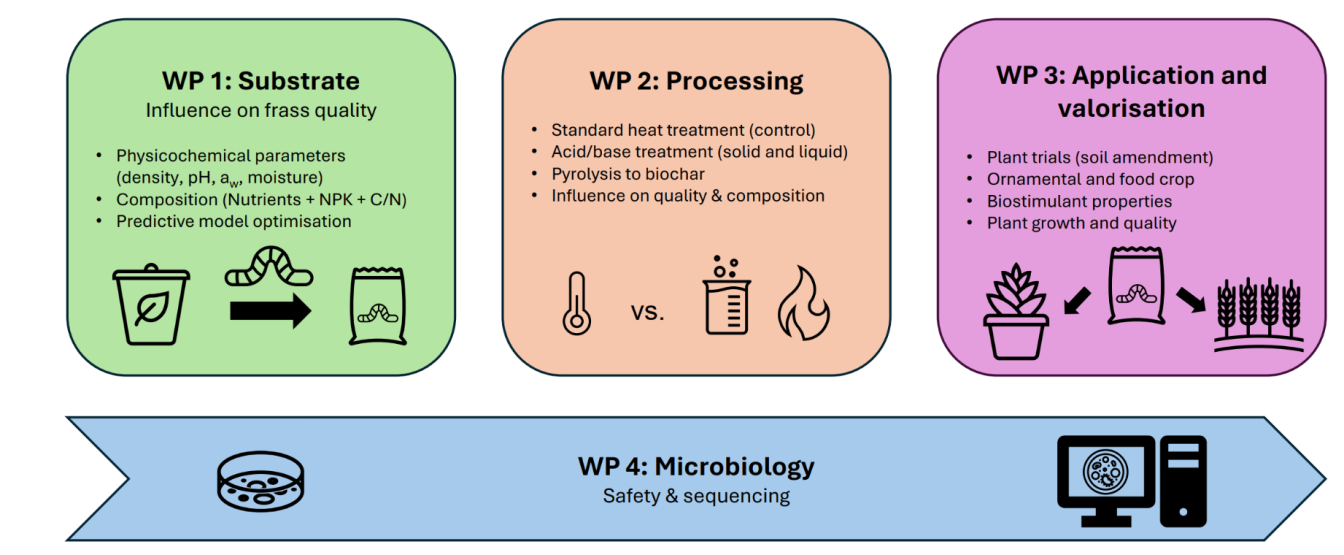
The overall aim of SUPRFRASS is to gain a comprehensive and applied understanding how rearing substrates and processing strategies influence the composition, safety, and application potential of BSF frass. Rather than treating frass as a residual by-product, the project positions it as a co-product whose value can be optimised for sustainable agriculture and the circular bioeconomy. The SUPRFRASS project specifically aims to:
Investigate substrate effects on frass quality by studying various organic by-products, including complex streams like meat and fish residues, to expand feedstock options and support regulatory evolution.
Evaluate processing strategies, thermal and innovative non-thermal methods (acid/base extraction, pyrolysis), to ensure safety, nutrient retention, and valorisation of both solid and liquid fractions.
Assess agronomic potential through plant trials under stress conditions to determine frass effectiveness as fertiliser, soil improver, or biostimulant.
Ensure microbiological safety by tracking microbial dynamics from substrate to plant systems, identifying hazards and benefits.
The project will deliver scientific insights, predictive models, and practical recommendations for safe, standardized, and high-value frass valorisation, contributing to resilient and sustainable agriculture in Flanders and beyond.
In October 2026, the team from the Expertise Centre for Sustainable Biomass and Chemistry gathered at the Insect Pilot Plant to count larvae as part of the SUPRFRASS research project. “We conducted an experiment in which we modified the diet of the BSF larvae,” explains researcher Boris Gilis. “We will now analyse how many larvae survived, how they grew, and how much frass, consisting of feed residues and excreta among other components, they produced.”
Further research may reveal whether this frass can be used as a biostimulant to promote plant growth. “We still need to determine whether any pathogens are present and whether it is safe for use in food production or animal feed.” Over the coming months, the larvae will undergo extensive analysis.